
LevelFields AI
Level 1 Subscriber Action Plan
Short-Term Trading Focus: 1–21 Day Hold Times
Your step-by-step guide to learning the platform and finding trades that work
TABLE OF CONTENTS
- Introduction: What You Are Working With
- Phase 1: Your First Day on the Platform (Day 1)
- Phase 2: Understanding the Key Concepts (Days 1–3)
- Phase 3: Choose Your Starting Scenarios (Days 2–5)
- Phase 4: Set Up Your Alerts (Days 3–5)
- Phase 5: How to Evaluate an Alert When You Receive It (Ongoing)
- Phase 6: Entry and Exit Rules for Short-Term Trades
- Phase 7: Your First Week Trade Routine
- Phase 8: The Most Important Filters for Short-Term Traders
- Phase 9: Your Short-Term Scenario Quick Reference
- Phase 10: What Level 1 Gives You and What It Does Not
- Your Master Checklist: Day-by-Day Action Plan
- Longer Term Investing Using LevelFields
- TLDR
Introduction: What You Are Working With
LevelFields AI monitors 6,300 stocks around the clock, 24 hours a day, 7 days a week. Its job is to read 30,000 documents per minute searching for specific events that are historically proven to move stock prices. When it finds one, it alerts you.
The platform is built around one core idea: events cause predictable price movements. Not always, not guaranteed, but with measurable win rates and average returns backed by years of historical data. Your job as a subscriber is to learn which events to focus on, set up your alerts, and execute trades when the data says the odds are in your favor.
This action plan is designed for someone using the Level 1 subscription who wants to be in and out of trades within 1 to 21 days. Everything in this guide comes directly from LevelFields' own learning materials.
If you are a longer term investor, and not a trader, please skip to section 2 at the end of the document for information on how to use LevelFields for mid and longer term investing.
Phase 1: Your First Day on the Platform (Day 1)
Step 1 — Log In and Go to the Scenarios Page
The Scenarios page is your home base. This is where all 24 event types are listed. Each one is a trading strategy.
On the Scenarios (Home) page you will see each scenario displayed as a card showing:
The name of the event type (e.g., Share Buyback, Activist Investor, CEO Departure)
Whether it is bullish (stock expected to go up) or bearish (stock expected to go down)
The win rate — what percentage of the time this event moved the stock in the expected direction. It can be affected by external, macro events. This means the correlation between the event and the stock price is likely much stronger than shown.
The average 1-day price move — how much the stock typically moved on the day of the event
The typical hold time — short-term, mid-term, or long-term
A ? icon. Clicking on it opens up videos and tutorials about that scenario.
Step 2 — Sort by What Matches Your Style
At the top of the Scenarios page, you can filter to show only:
Bullish scenarios — events that push stocks up
Bearish scenarios — events that push stocks down
Highest win rate — events that are most historically reliable
Most Events - scenarios where events happen a lot.
If you want trades you can enter and exit within 1 to 21 days, look for scenarios that show short-term or 1-day hold time indicators on the card. The platform flags these so you know at a glance whether a scenario is a quick trade or a multi-month hold.
Step 3 — Do Not Touch the Alerts Yet
Before you set up any alerts, spend your first day just reading. Click on 2 or 3 scenario cards, their tutorials, and explore what the data looks like. You are not trading yet. You are learning the language of the platform.
Phase 2: Understanding the Key Concepts (Days 1–3)
Before you make a single trade, you need to understand these concepts. They are used everywhere on the platform.
What Is a Scenario?
A scenario is a group of similar events that have been proven to move stock prices in the same direction. Every scenario has a win rate and a typical price impact. Some scenarios are for stocks going up. Some are for stocks going down. Most events within a scenario follow the same pattern.
Examples of bullish scenarios: Share Buybacks, Activist Investor filings, Billion Dollar Contracts, Dividend Increases, Breakthrough Therapy Designations.
Examples of bearish scenarios: CEO Sudden Departures, DOJ Investigations, Class Action Lawsuits, Mass Layoffs at unprofitable companies.
What Is the 1D Impact?
This is the price change measured from the closing price on the day BEFORE the event to the closing price following the event. If an event happened after 4pm, the 1D Impact measures from that day's close to the next day's close. This tells you how much the stock typically moves in the first 24 hours after an event. It is standardized to cover the same time period regardless of when an event occurs to standardize the analytics.
What Is the AVG 1D Return?
This is the average of all individual event impacts across all events in the scenario. Think of it like the average temperature for a month. It gives you a general sense of how events in that scenario typically perform, not a guarantee for any single trade.
It can be influenced by the sector, industry, size, or financials of the company.
For best results, group apples with apples - this means use the filters to group similar companies together and then look at the Avg. 1D Return. It changes as the filters change. This is the arguably most powerful feature on the platform.
What Is the Table View?
Inside each scenario, there is a Table View. This shows you every individual event that has happened, along with what the stock did on Day 1, Day 2, Day 3, Day 5, and over longer periods like 1 month and 6 months. This is critical for short-term traders because you can see exactly when the price move tends to peak and when it tends to fade. This is a key ingredient for success and another major differentiator from just a news feed.
What Do Filters Do?
Filters are one of the most powerful features on LevelFields. They let you narrow down the events in a scenario by characteristics like company size, profitability, sector, trading volume, and more. When you apply filters, the win rate and average returns update to reflect only those filtered events.
For example, the layoffs scenario is typically bearish. But if you filter for large-cap profitable companies only, the scenario turns bullish. That is because layoffs at big profitable companies are seen as cost-cutting that improves earnings. Filters reveal patterns within patterns.
Phase 3: Choose Your Starting Scenarios (Days 2–5)
Since you want short-term trades of 1 to 21 days, here are the scenarios from LevelFields' own learning materials that are best suited to your timeframe.
Your Primary Focus Scenarios for Short-Term Trading
Scenarios to Avoid at First (Too Complex or Too Long-Term)
Alzheimer's Trial Results — requires deep biotech knowledge
CEO Hired — Movement depends on financial strength. Stock rises for poor performers (Starbucks 2024) and sinks for strong performing companies (Amazon 2023) long-term play, results take months to show
Bankruptcy Restructuring — very specialized, longer hold required
S&P 500 Inclusion — moves quickly due to insider trading. Slower-building from there
Amazon Launches — designed to identify market disruptions to OTHER companies negatively impacted by Amazon becoming their competitor. Takes more research but can affect 3-6 other companies if they enter a new industry (e.g. used cars, telemedicine, cloud services, advertising, robotaxis)
Tesla Launches — there to show options traders how to trade these events using more complex option setups like strangles and straddles
Dividend Reduction — movement really depends on company’s situation. Sometimes it’s a prudent move applauded, other times it’s a red flag of a sinking ship. Fundamental analysis required to understand the situation
Mass Layoffs - Movement depends on financial strength. Stock rises for strong performers (META) and sinks for poor performing companies (Nike). Need to understand how to use the filters but very powerful for short and longer term moves.
Phase 4: Set Up Your Alerts (Days 3–5)
Alerts are how LevelFields notifies you the moment a qualifying event is detected. Without alerts, you would have to manually check the platform all day or sit over streams of news and X posts missing most. With alerts, the platform does the watching for you.
How to Set Up a Scenario Alert (Step by Step)

Go to the Scenarios page and click on the scenario you want to track

Browse the data to understand what kinds of events appear in this scenario

When you are ready, click the big green Create Alert button

Name your alert clearly (e.g., Share Buyback Alert or Quick Sprint Alert)

Go to My Alerts and click the bell icon next to your new alert
 Set your delivery preference — either immediately when detected, or once per day at a time you choose
Optional: Add filters before creating the alert to narrow down to only the events most likely to move
How to Set Up a Customized Alert (with Filters)
A customized alert only fires when an event matches your specific filter settings. This reduces noise and surfaces only the highest-probability setups.
Example setup for a short-term trader:
Scenario: Share Buybacks
Filter: Large Cap or Mid Cap companies only
Filter: High volume (so you can actually trade it easily)
Filter: Profitable companies only (buybacks matter more when the company is healthy)
Then click Create Alert.
Now you only get notified when a profitable, large or mid-cap company with high trading volume announces a buyback. That is a much more focused signal.
Phase 5: How to Evaluate an Alert When You Receive It (Ongoing)
When an alert arrives, do not just buy the stock immediately. Use this checklist to evaluate whether the trade is worth taking.
Your Trade Evaluation Checklist
Phase 6: Entry and Exit Rules for Short-Term Trades
This is where most new traders lose money — not from bad stock picks, but from bad entry and exit timing. These rules come directly from LevelFields' own guidance.
Entry Rules
Do not buy at the very first spike after news. Pre-market spikes often pull back at the open as profit-takers sell. The stock may drop 20 to 30 percent from its spike high before finding support.
Wait for the stock to stabilize. This often happens between 10am and 12pm on the day of the announcement. The panic selling stops, buyers step back in, and the stock finds a floor.
Buy near support, not at the peak. Let the initial euphoria cool. You want to enter as the stock consolidates, not as it is spiking up.
Use limit orders. Never use market orders on volatile stocks. Set your limit at the price you are willing to pay and let it fill.
Exit Rules
Lock in gains when they come. LevelFields says it directly: if the stock is up 10% in 5 days and you were targeting a 10-day hold, there is no need to wait. You won. Take it.
Do not hold hoping for more if the move has already happened. Stocks give back gains quickly after catalysts fade.
Set a mental stop loss before you enter. Know exactly how much you are willing to lose. A common rule is exiting if the stock drops 8 to 10 percent from your entry.
Have a time stop. If the stock has not moved in your expected direction within the timeframe you expected, exit. Holding longer because you hope it will work is not a strategy.
Phase 7: Your First Week Trade Routine
Once you have your 1 to 2 scenarios selected and your alerts set up, here is what your daily routine should look like.
Morning Routine (Before 9:30am Eastern)

Check your email or phone for any LevelFields alerts that arrived overnight or in premarket

For each alert, ask: Is this event large enough? Is the company profitable? What does the scenario data say about Day 1 moves for this type of event?

Decide whether you will trade this alert today or pass

If trading, decide your entry price, target exit price, and stop loss price before the market opens

Set your limit order and wait
Midday Check (10am to 12pm Eastern)

This is the best entry window for stocks that spiked at the open and have pulled back

Check if any stocks from your alerts have settled at a support level

Review any open positions. Are they moving as expected?
End of Day (3:30pm to 4pm Eastern)

Review your open positions. Are you up or down from your entry?

Check the scenario Table View for stocks you hold. Are you within the typical move window?

Decide whether to hold overnight or exit today

Set any stop loss orders for overnight holds
Phase 8: The Most Important Filters for Short-Term Traders
LevelFields says in their learning materials that the most important filters are the ones that increase the quality and predictability of events. Here are the filters most relevant to someone trading 1 to 21 days.
Phase 9: Your Short-Term Scenario Quick Reference
Use this reference guide every time you receive an alert. Match the scenario to the expected move window and exit timing.
Phase 10: What Level 1 Gives You and What It Does Not
LevelFields is transparent about this. Understanding what is and is not included in your subscription will help you use it correctly.
For your goals — short-term trades of 1 to 21 days — Level 1 gives you everything you need to get started. You have the scenarios, the data, the filters, and the alerts. That is the foundation.
Your Master Checklist: Day-by-Day Action Plan
Day 1

Log in to LevelFields for the first time

Go to the Scenarios page and spend 30 minutes just browsing scenario cards

Read the win rate and 1-day impact on at least 5 different scenarios

Click into Share Buybacks and read the Table View data

Click into Quick Sprints and read the Table View data

Do NOT set any alerts yet. Just read and explore.
Days 2–3
 Decide on your 1 to 2 focus scenarios (recommended starting point: Share Buybacks and Quick Sprints)
Apply filters to each scenario and watch how the win rate and average return change

Find the filter combination that produces the best win rate for your chosen scenario

Read about your scenarios in LevelFields' learning center or ask me to explain any concept
Days 4–5

Set up your first alert for your primary scenario with your chosen filters

Set up SMS or email delivery for premarket alerts
 Paper trade your first 3 alerts — meaning, write down what you would have bought, at what price, and what your target exit would be, but do not actually trade yet

Review the results of each paper trade against what actually happened
Week 2

Begin trading with small position sizes (no more than 2 to 5 percent of your account per trade)

Follow your entry and exit rules strictly

Record every trade: scenario, entry price, exit price, days held, and outcome

After 5 trades, review your results and adjust your filters if needed
Week 3 and Beyond

Add a second scenario to your alert setup once you are comfortable with your first

Use the Trends section to identify broader market patterns affecting your trades

Review your trade log weekly and identify what is working and what is not
Longer Term Investing Using LevelFields
Which Scenarios Can be Used for Longer Hold Times?
TLDR
Dividend Increase
Dividend Creation
Activist Investor
Alzheimer's Trials
Added to S&P Small Cap
Breakthrough Therapy
Billion Dollar Contracts
Bankruptcy
CEO Hired
Mass Layoffs
LevelFields identifies events that change a company's trajectory or mark a major catalyzing event in a company's lifecycle. All events can be traded short term, and many of them can be traded long-term as well. Below, we'll cover how to use these events for longer term hold times.
Dividend Increases
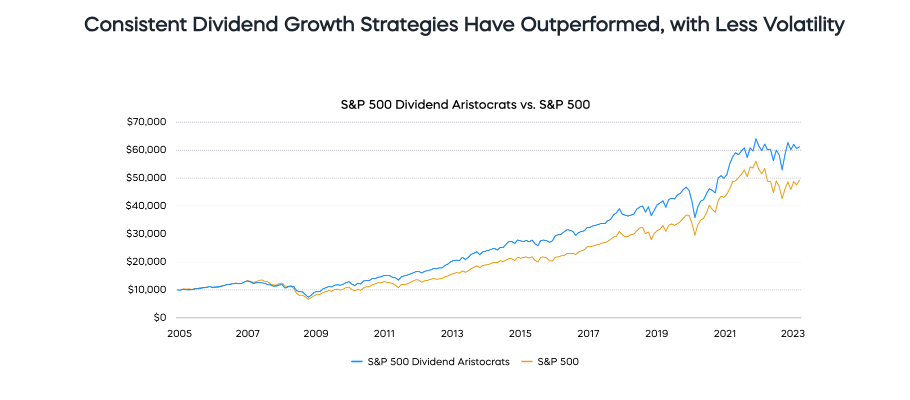
Companies that raise their dividends by a significant amount are signifying that they are in good financial health and the future looks like things will stay this way. Companies that raise their dividends by double digit amounts regularly outperform peers and the S&P 500.
So what is a significant dividend increase?
The answer really depends on how big the dividend is in the first place. If the dividend amount is 1 cent and the company raises it to 2 cents, that is a 100% increase but the total dividends allocated is still small so the increase is not going to get any investors excited about getting more cash. For this, it's best to look at the dividend yield - the dividend divided by the share price x 100.
To get going, start with companies that have a dividend yield of at least .5 percent. This will eliminate some of the noise in the data sets.
A dividend increase of 10% is a lot for a company that has a dividend yield above 2% but not much for a company with a dividend yield of .5%. So the increase is relative to the starting point based on how much more money the company is giving out per share.
A good rule is to not get excited unless the numbers are 10 on 1 - a 10% increase on a 1% yield. Above that is great and will often be a good long-term and short-term investment.
Dividend Creation
Companies that create a dividend are sending a strong message of "we're here to stay and are so confident in our cash position and revenue position we're giving away operating capital we don't need." There are few statements more powerful than actions.
As a result, the creation of a new dividend is a bullish indicator for longer term success IF the company has revenue growth. However, if the company is high growth tech or healthcare company, the creation of a dividend program may be perceived as the company giving up on growth to become a slower growing company. In this case, there's often a selloff of shares as investors looking for high growth get discouraged by the transformation.
It's important to note that the further away from an event in time, the more confounding variables can affect a share price. So while the creation of a dividend is a bullish event, typically, other factors such as earnings growth, revenue growth, competition, and macroeconomic conditions can affect the company's price performance over longer periods.
Activist Investor
Activists are wealthy investors that buy over 5% of a company's outstanding stock and attempt to take an active role in the company's management by influencing the Board or CEO to take actions that benefit shareholders. Famous activist investors include Bill Ackman, Carl Icahn, and Nelson Peltz. There are many activist investors out there.
After an activist takes a position, they seek to cut costs, grow revenues, increase profits, and reward shareholders with dividends or upward price action on the stock. There are a variety of ways activist investors can help the stock price, but it is not an overnight event. Often activists must convince other shareholders to vote a certain way to replace Board members or a CEO. Because of this, the Activist Investor scenario is a longer term scenario, as the activist needs 6-12 months to enact these changes to the point where the company begins to see an impact.
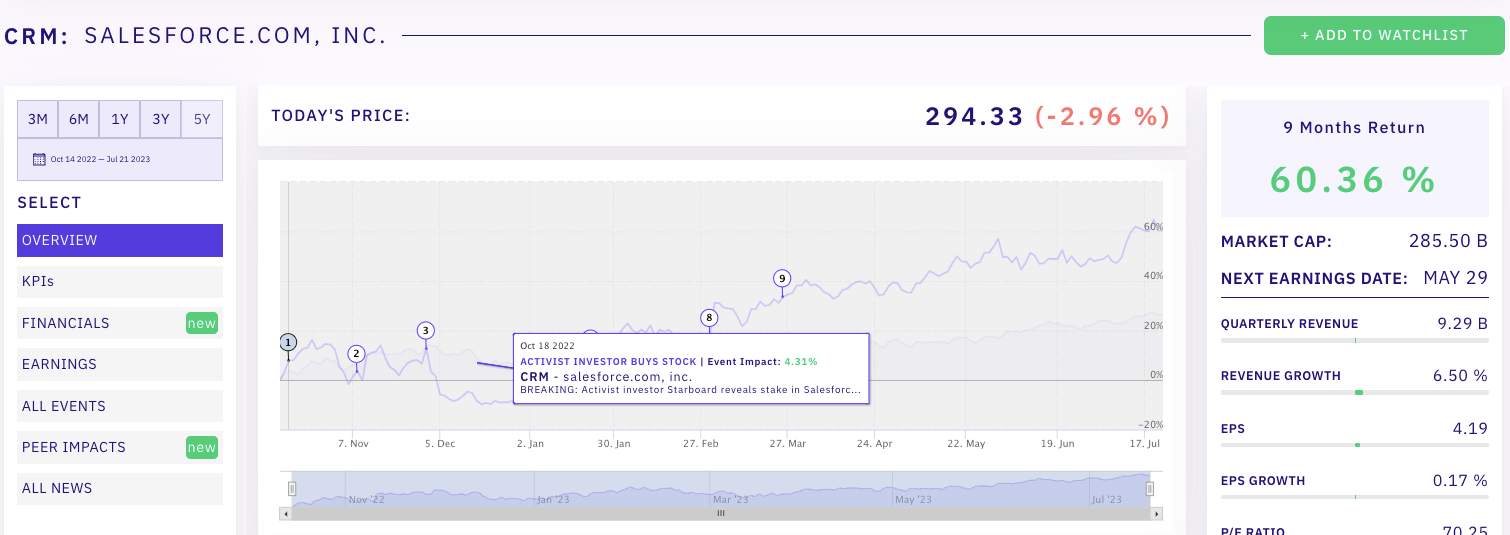
Salesforce is a great case study in activist investors. The company, known for its enterprise CRM software, was influenced heavily by two different activist investors. Over a 9-month period following the first activist investor coming in, Salesforce's stock price increased by 60%.
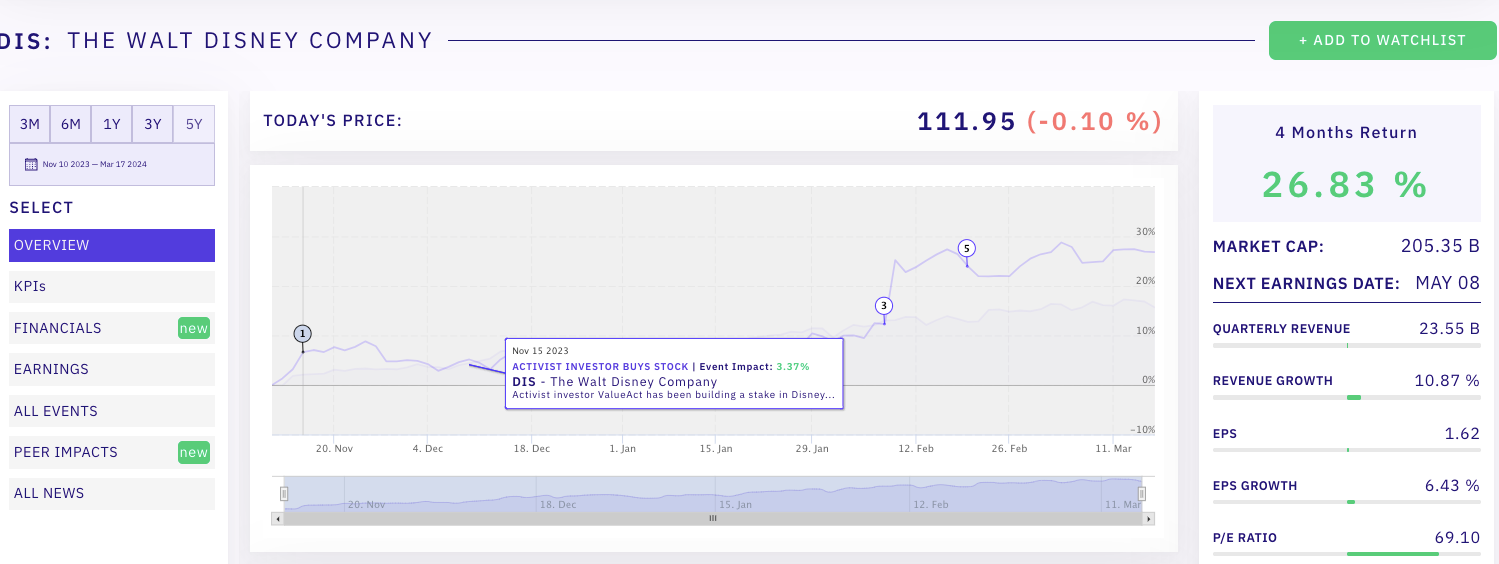
Disney engaged in a battle with activist investor Nelson Peltz, who was trying to make Disney more profitable and focused on profits. The activist investor came into the company in November 2023. Over the following 4-months, shares rose 26% on news the activist investor was pushing for changes at Disney, which investors and analysts liked.
Additionally, the following scenarios can be used for longer term investors.
Alzheimer's Trials --> identifies potential blockbuster drugs
Added to S&P Small Cap --> a significant moment for a growing company which makes the stock more widely bought and known
Breakthrough Therapy --> marks a drug or medical therapy that is superior to existing therapies. If the market size is large enough, sales can be in the billions per year following their clinical trials. This takes years.
Billion Dollar Contracts --> provide companies with large revenue and profit possibilities to expand growth. One contract can provide many years of growth.
Bankruptcy --> companies that restructure their debt and emerge from bankruptcy can be long term winners (e.g. hertz, GM, Ford)
CEO Hired --> a new CEO can turn around an ailing company (e.g. Disney, Stabucks)
Mass Layoffs --> While this can be a bad sign for a struggling company, it's an essential part of a larger company's ability to scale profits successfully (e.g. META).
Video Tour
More Articles:
What is event-driven investing?
Important Disclaimer
This action plan is based on LevelFields' own published educational materials and is intended for learning purposes only.
Historical win rates and average returns do not guarantee future results. All trading involves risk of loss.
This is not financial advice. Always do your own due diligence before placing any trade.
Join LevelFields now to be the first to know about events that affect stock prices and uncover unique investment opportunities. Choose from events, view price reactions, and set event alerts with our AI-powered platform.
Don't miss out on daily opportunities from 6,300 companies monitored 24/7. Act on facts, not opinions, and let LevelFields help you become a better trader.