
Dividend Creation: How These Events Impact Stock Prices
When a company initiates a dividend for the first time, it sends a clear signal to the market. Dividend creation events often indicate that a business has reached a stage where cash flows are stable enough to support recurring shareholder returns. This shift can change how a stock is perceived, attracting a new class of investors focused on income, stability, and capital discipline.
Unlike dividend increases, which reward existing income investors, dividend creation expands the investor base, often leading to sharp short-term price reactions followed by longer-term re-rating effects.
Why Dividend Creation Moves Stocks
Dividend initiation creates demand from multiple sources at once:
Income-focused investors and funds that previously could not hold the stock
Dividend and factor-based ETFs that screen for yield or shareholder return policies
Fundamental investors who view dividend initiation as a signal of financial maturity
For smaller and mid-cap companies, this effect can be amplified. These stocks often have lower baseline liquidity, so incremental buying pressure can translate into larger percentage price moves.
Over time, ongoing dividend payments can also support valuations by anchoring expectations around cash generation and shareholder returns.
Case Study: CuriosityStream (CURI)
CuriosityStream provides a clean example of how dividend creation events typically play out.
The Announcement
On March 20, 2024, CuriosityStream announced the creation of a cash dividend, marking the first time the company committed to returning capital directly to shareholders. The announcement detailed management’s intention to use excess cash to provide shareholder returns while continuing to invest in content and platform growth.
This was not a dividend increase or special dividend — it was a structural change in capital allocation policy, which is why the market reaction was immediate and significant.
Immediate Price Reaction (Day 1)
Following the announcement:
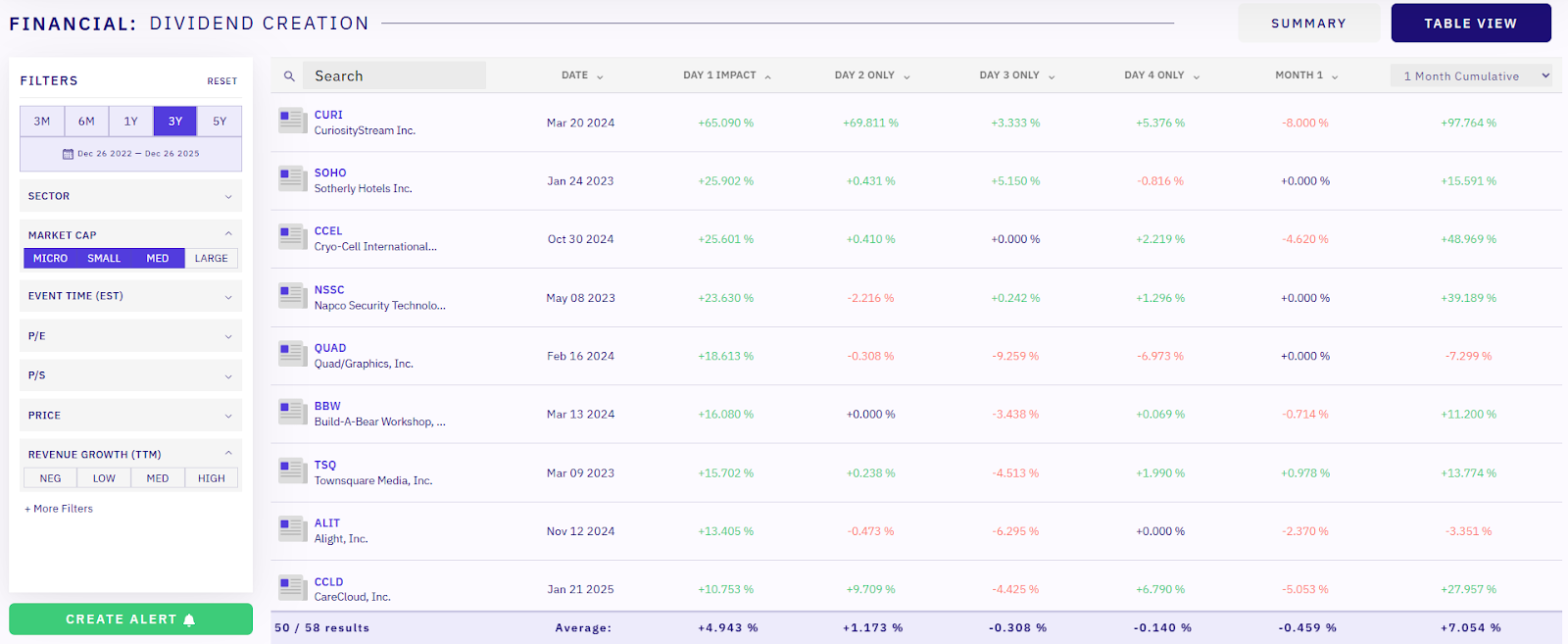
The stock surged +65.09% on Day 1
Trading volume spiked sharply, indicating broad participation
The move occurred rapidly, consistent with traders and funds repositioning after the announcement
This aligns with broader Dividend Creation scenario data, where initial reactions tend to be front-loaded as new buyers enter quickly.
Follow-Through in the First Few Days
Price behavior after dividend creation often differs from traditional news-driven spikes:
Day 2: Continued strength (+69.81% cumulative impact shown in scenario data)
Days 3–4: Volatility increases as short-term traders take profits
By the end of the first week: Price typically stabilizes above pre-announcement levels
This pattern reflects the handoff from fast-moving traders to slower-moving investors who are reassessing the stock under a new valuation framework.
One-Month Performance
For CuriosityStream:
1-month cumulative return: approximately +97.76%
Despite short-term pullbacks within the month, the stock remained well above its pre-dividend-announcement price
This behavior is consistent with dividend creation acting as a re-rating event, not just a one-day trade
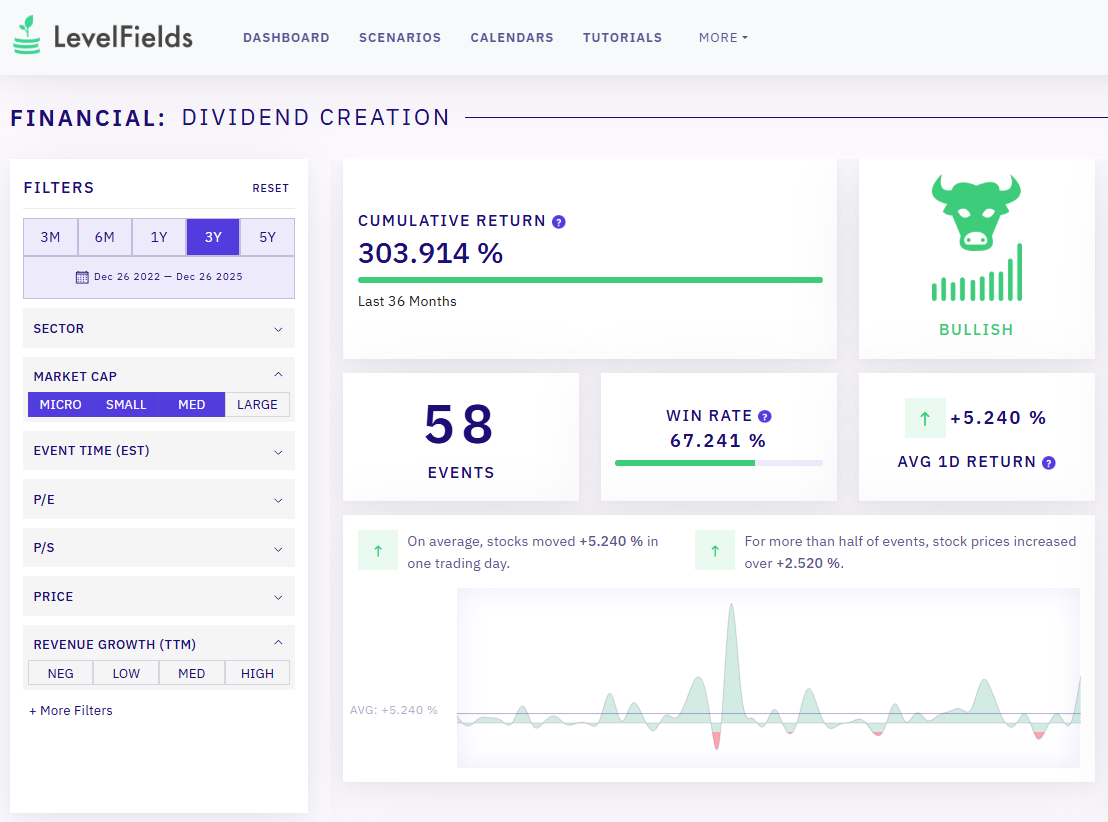
Across the broader Dividend Creation scenario:
Average 1-month cumulative gain: approximately +7.05%
While not every stock sustains extreme upside like CuriosityStream, the data shows that returns often persist beyond the initial announcement window
How to Trade the Dividend Creation Scenario
Dividend creation events tend to offer multiple trading and investing approaches, depending on timeframe:
Short-term traders often focus on the announcement reaction and early follow-through, particularly in lower-liquidity stocks
Swing traders may target pullbacks after Day 1 or Day 2 as volatility compresses
Longer-term investors can use dividend creation as a screening tool for companies entering a new phase of financial stability
It’s important to note that LevelFields metrics measure price changes from the close before the event to the close after each day. Intraday highs may exceed what is captured in the summary statistics, meaning realized opportunity can be larger than the data alone suggests.
Key Considerations and Caveats
Dividend creation does not guarantee future dividend growth
Some companies initiate dividends opportunistically and may later suspend them
The sustainability of the dividend depends on cash flow, balance sheet strength, and capital requirements
Reading the announcement details matters. Investors should understand:
Dividend size
Payment frequency
Management commentary on capital allocation
These factors influence whether the market treats the dividend as a one-time signal or a long-term policy shift.
How LevelFields Helps
LevelFields alerts users when a company creates a dividend for the first time and provides:
Historical performance data across similar events
Day-by-day impact analysis
Short- and longer-term cumulative return tracking
This allows traders and investors to evaluate how dividend creation events have historically played out — and decide how, or whether, to participate.