
Dividend Increases
TLDR:
Dividend Increases = a company raises the cash it pays shareholders per share
Best for: income investors, beginner investors, options income traders, swing traders
Focus on quality + sustainability (yield, payout ratio, earnings/FCF)
Use LevelFields to get alerts at announcement and follow monthly roundups (example: “Largest Dividend Increases for November 2025”)
If you’re just getting started with LevelFields (and investing), the amount of data can feel overwhelming. One of the simplest ways to make it manageable is to focus on one scenario that is easy to understand and easy to execute.
Dividend Increases are one of the most beginner-friendly scenarios because they’re a clear signal of shareholder returns, and they often create both:
a bigger cash payout, and
a price reaction as income-focused investors rotate into the stock.
What is a dividend increase?
A dividend increase happens when a company’s board votes to raise the amount it pays shareholders per share (usually quarterly in U.S. markets).
Example:
If a company paid $0.50/share and raises it to $0.60/share, that’s a 20% dividend increase.
Dividend increases are commonly associated with:
improving earnings
rising free cash flow
strong balance sheets
management confidence in future results
The 4 dividend dates you should know
If your goal is to receive the dividend, timing matters. These are the key dates:
Declaration date: the company announces the dividend amount and dates
Ex-dividend date: the cutoff date to be eligible (buying on/after this date means you miss the payout)
Record date: the date the company checks who owns shares
Payment date: when the cash hits your account
These dates are published by the company and widely tracked after the announcement.
What counts as a “significant” dividend increase?
A dividend increase is only meaningful if it moves real dollars relative to the stock price. That’s why dividend yield matters (dividend ÷ share price).
A simple rule to keep it practical:
Rule of “10 on 1”:
Don’t get excited unless the numbers are at least 10 on 1 → a 10% increase on a 1% yield.
Why this helps:
A 100% increase on a tiny dividend can still be irrelevant in real dollars
A smaller percentage increase on a higher yield can matter more to investors
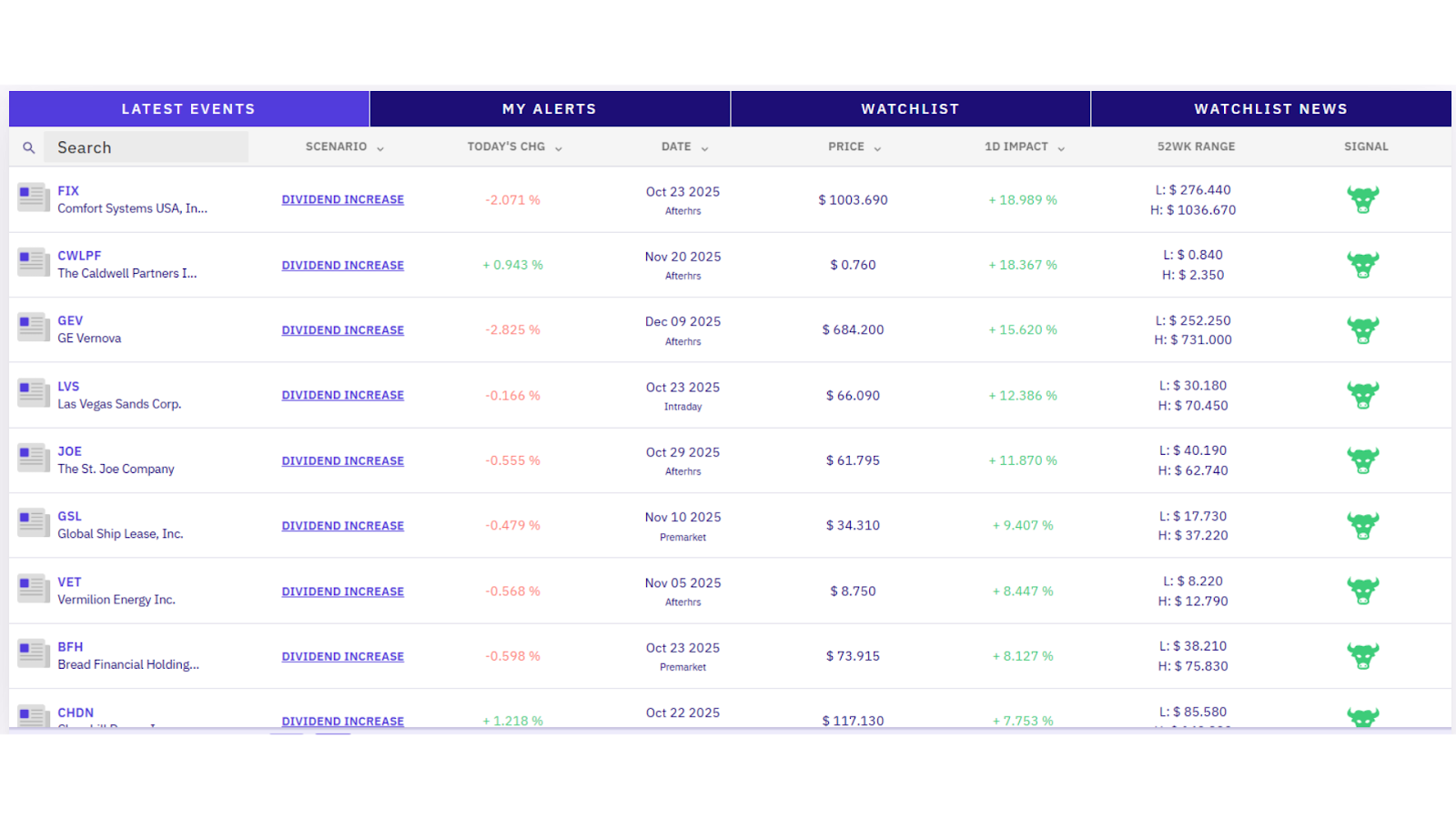
Why dividend increases matter for investors
Dividend increases can signal:
financial strength (the company can afford higher payouts)
income growth (cash flow to you rises over time)
market perception shift (income funds/ETFs often respond to improved payout profiles)
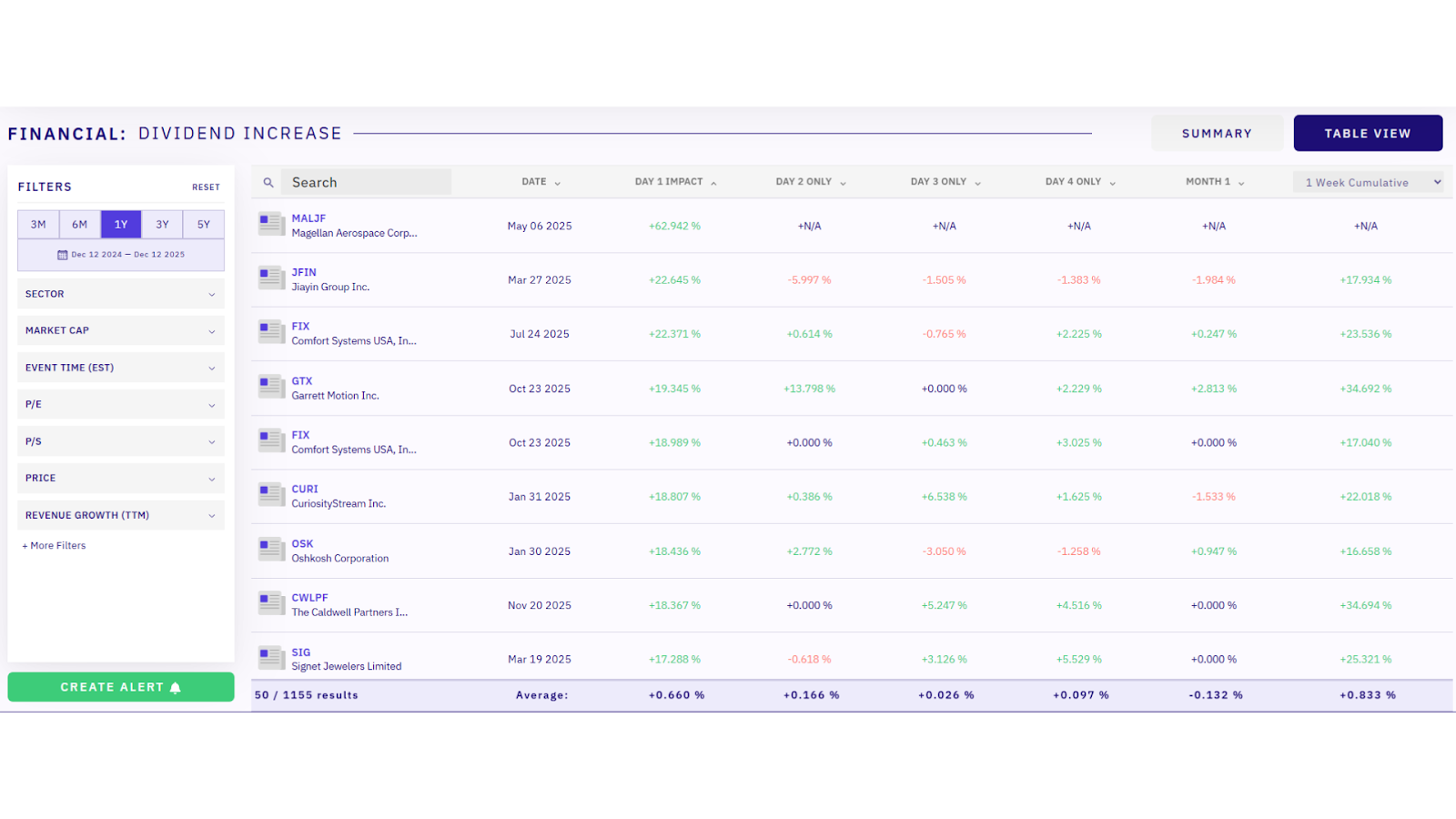
They can also act as a sentiment cue. For example:
Disney declared a $1.00/share cash dividend in December 2024, a 33% increase over the prior year’s payout.
General Motors announced a 25% quarterly dividend increase (from $0.12 to $0.15) alongside a $6B buyback authorization in February 2025.
American Express approved a 17% dividend increase to $0.82 per share in March 2025 (from $0.70), including record and payment dates.
JPMorgan Chase announced a dividend increase from $1.25 to $1.40 in March 2025, with published record and payment dates.
Deutsche Bank proposed a dividend of €0.68/share for 2024, a 50% increase vs. the prior year.
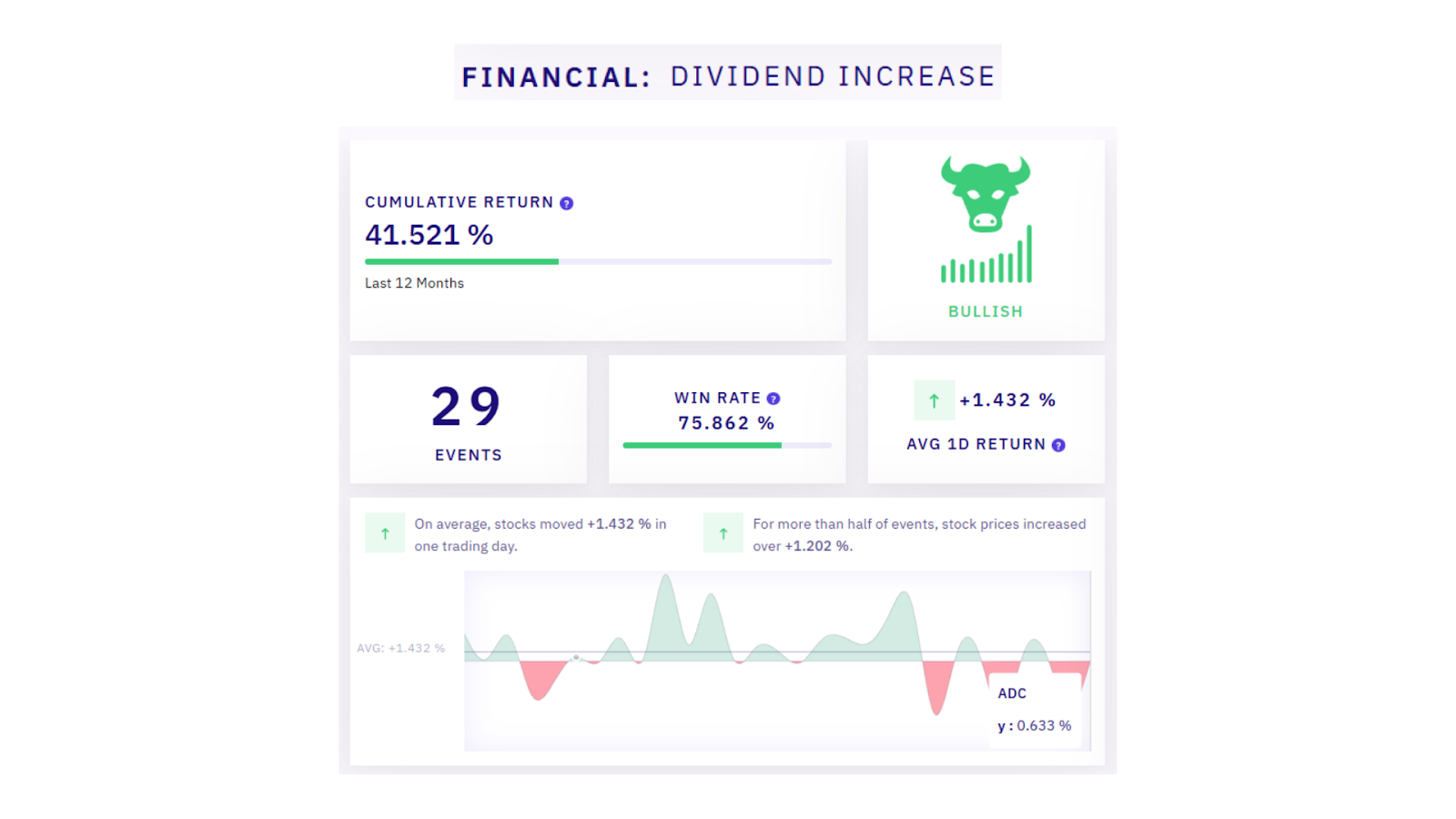
Spot dividend increases faster with LevelFields
Most investors learn about dividend changes after they’ve circulated through headlines and data feeds. LevelFields is built to help you act at the time of announcement and reduce manual tracking.
With LevelFields, you can:
Get instant notifications when a company declares a dividend increase
Filter for companies with 5, 10, 15+ years of dividend growth
Screen for preferred traits (yield range, payout behavior, stability)
Save custom filters aligned with your portfolio goals
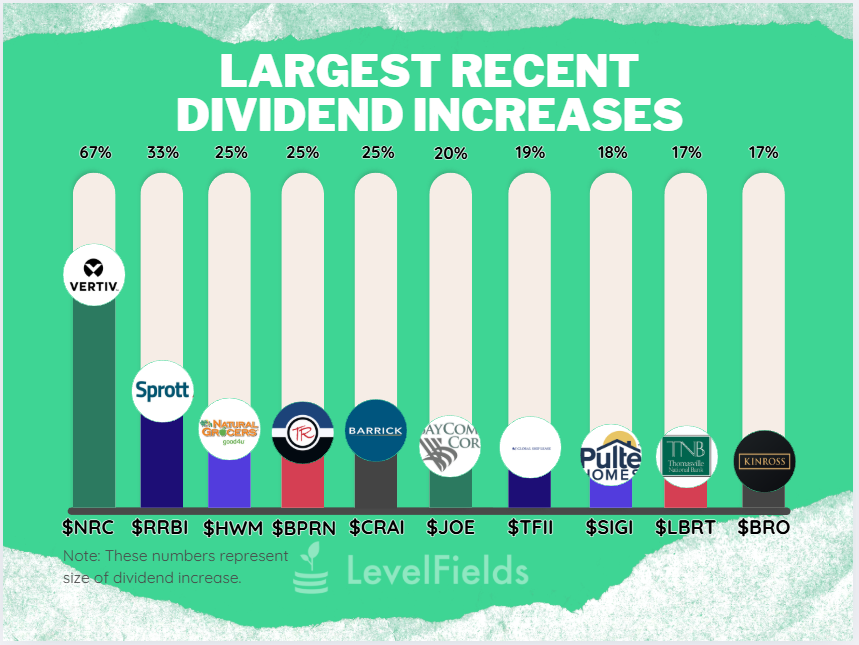
Monthly roundups: LevelFields also publishes monthly lists (example: “Largest Dividend Increases for November 2025”) so you can review the biggest raises in one place and track sector patterns.
Pro tip
Dividend increases work best when paired with strong fundamentals. Avoid companies raising payouts while earnings or financial health deteriorate, and treat dividend increases as one piece of a broader income approach that can also include other dividend strategies (like tracking consistent dividend growth over time).
Bottom line
Dividend increases matter because they combine two things investors care about:
more cash paid per share, and
a market signal that can impact price and demand.
If you want a simple workflow, focus on:
the yield,
the size of the increase, and
the earnings/FCF context.
Want to go one step further?
If dividend increases are about growing income over time, special dividends focus on short-term cash returns tied to one-off corporate events.
Special dividends can deliver meaningful payouts in just days—often without requiring a long-term hold—and are a natural complement to a dividend-growth strategy.
To learn how special dividends work, how to time them correctly, and what to watch out for, read:
What Are Special Dividends and How to Trade Them? (Link)