
Short Seller Reports: What Actually Happens After the Headline
Short seller reports don’t move stocks because they’re always right.
They move stocks because they introduce doubt at scale.
When a short thesis is published, markets react before verification. Liquidity thins, risk managers act, and price adjusts rapidly to reflect uncertainty—not conclusions. The result is often a sharp initial drop, followed by a period where the market reassesses what truly changed.
This scenario focuses on that transition.
A Real Example: AppLovin (APP)
The Moment
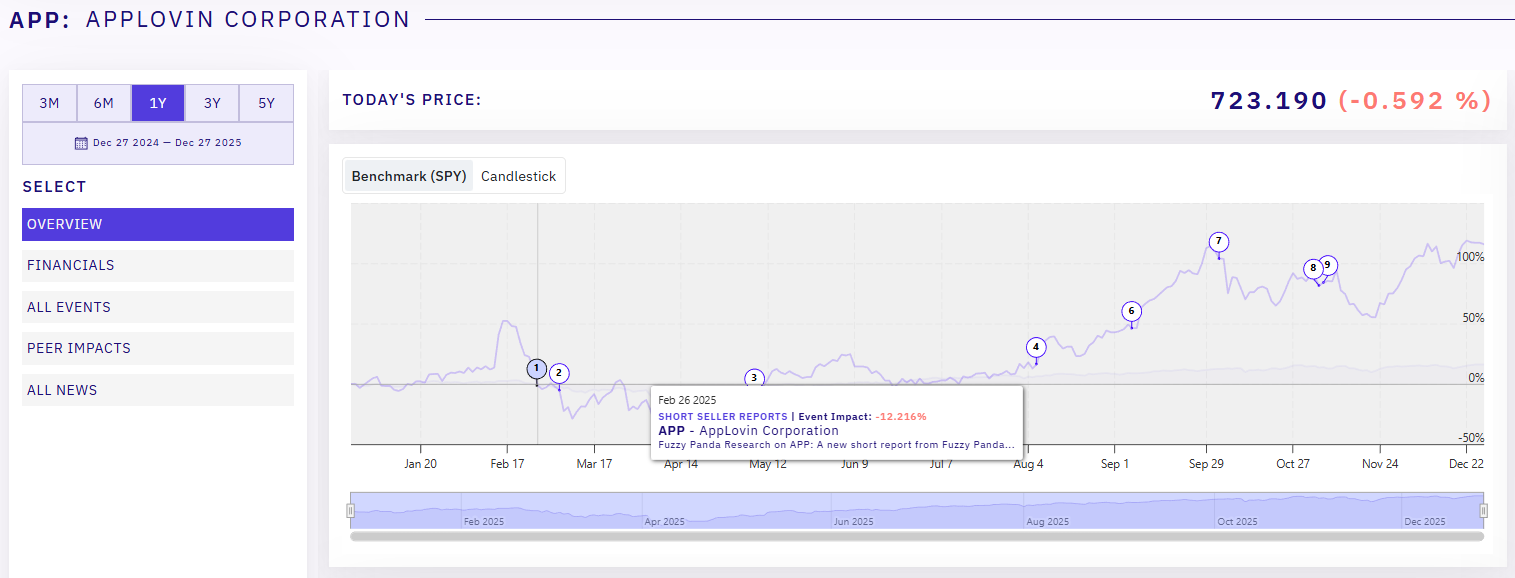
On February 26, 2025, a short seller released a public report targeting AppLovin. The report questioned elements of the company’s business model and valuation assumptions and spread quickly during market hours.
No regulatory action occurred. No earnings revision followed.
But price moved immediately.
That response alone placed the event into the Short Seller Reports scenario.
The First Reaction: Fast, Mechanical, Unforgiving
The market’s initial response was not subtle:
Day 1 decline: -12.216%
Selling pressure emerged almost immediately
Volume rose as funds and traders reduced exposure
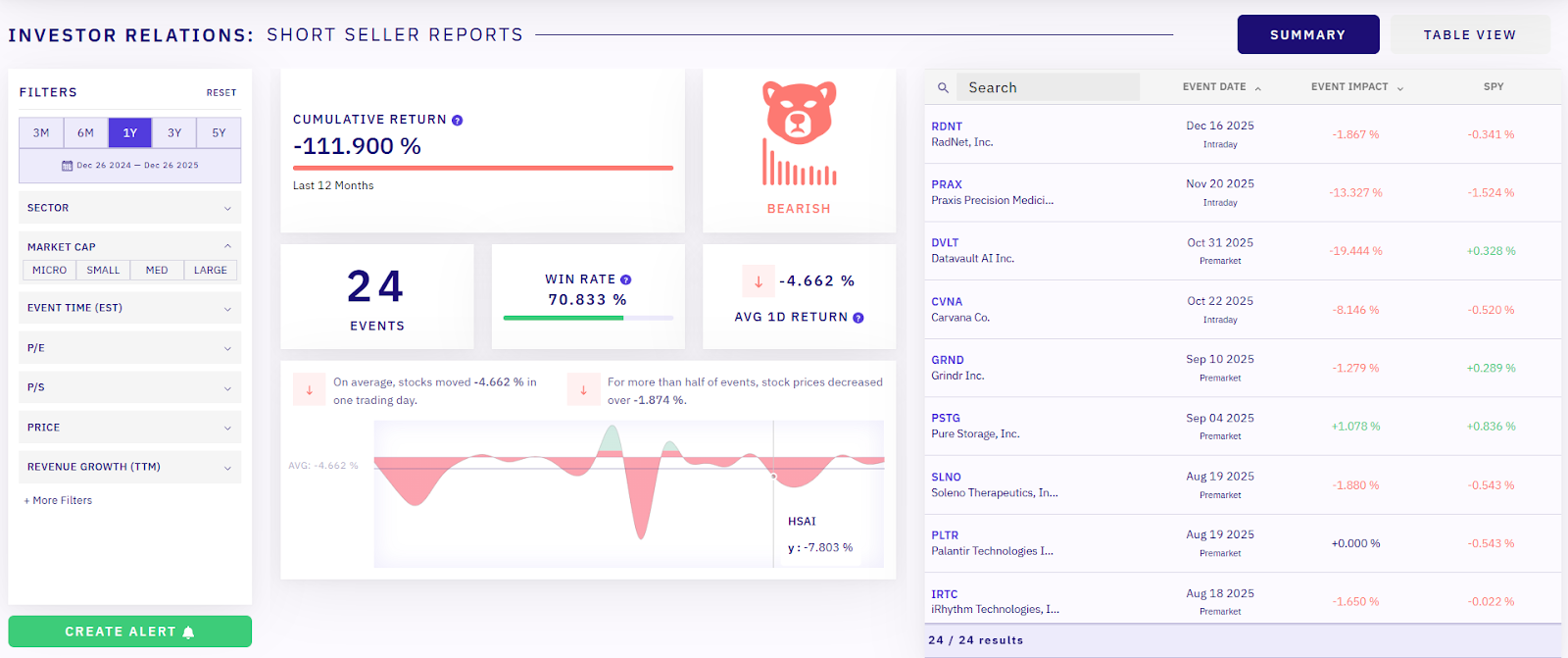
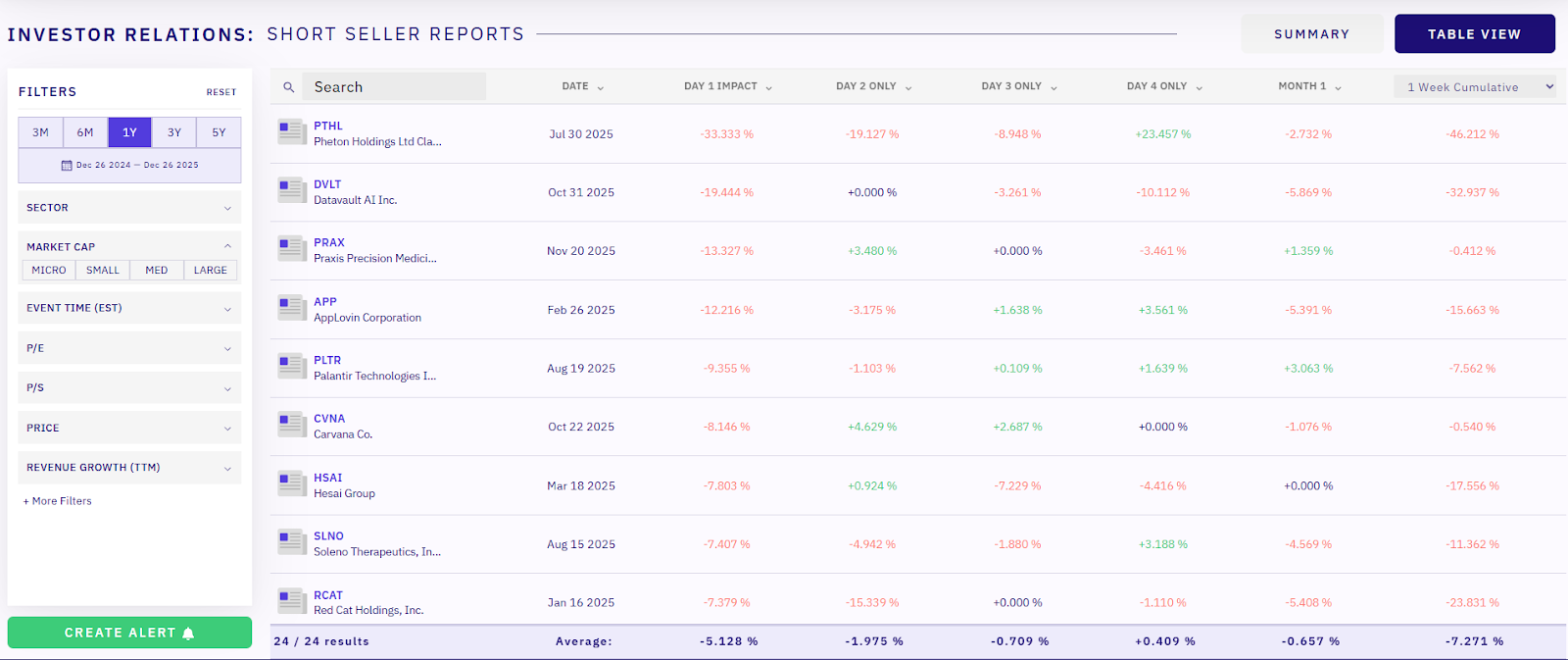
This type of move is common. Across the broader scenario, short seller reports produce downside Day 1 moves roughly 71% of the time, with an average decline of about -4.7%.
AppLovin’s drop exceeded the average—reflecting its liquidity, visibility, and prior momentum.
At this stage, price action reflects risk removal, not analysis.
What Changed—and What Didn’t—Afterward
Once the initial selloff passed, the behavior shifted.
Day 2: Continued weakness, but at a slower pace
Days 3–4: Price stabilized and began to rebound modestly
End of Week: Losses had narrowed rather than expanded
This matters. In short seller scenarios, the absence of new information often becomes information itself.
For AppLovin:
No immediate regulatory follow-up emerged
No accounting restatement occurred
No guidance revision followed
As a result, the market transitioned from reaction to reassessment.
The Legal Echo
On March 5, 2025, AppLovin became the subject of a class action lawsuit announcement, reported via GlobeNewswire. The filing referenced investor losses following the earlier short seller report.
This development did not restart the selloff—but it mattered. Class action filings often trail volatility and restate existing allegations rather than introduce new facts. Because this lawsuit did not materially expand the original claims, the price reaction was incremental, not severe.
What This Timeline Shows
AppLovin’s sequence highlights a common short seller report lifecycle:
Initial shock — rapid repricing of uncertainty
Stabilization — volatility compresses as claims are assessed
Secondary pressure — legal or regulatory echoes reinforce risk
Resolution — price ultimately follows fundamentals, not headlines
The largest move typically occurs first. Follow-on events tend to carry diminishing marginal impact unless new evidence emerges.
The Broader Pattern This Reveals
Short seller reports tend to follow a familiar arc:
Shock phase – rapid repricing driven by uncertainty
Stabilization phase – volatility compresses as claims are evaluated
Resolution phase – price either resumes its prior trend or continues lower if new evidence appears
AppLovin moved clearly out of the first phase and into the second.
By the one-week mark, the cumulative decline had moderated compared to the initial drop. Over the following weeks, price behavior reflected balance, not panic.
Why the Biggest Move Is Usually the First One
LevelFields data consistently shows that the majority of downside risk in short seller reports is front-loaded.
That’s because:
Funds act before details are digested
Algorithms respond to sentiment and headlines
Buyers temporarily step aside
Unless the report triggers concrete consequences, follow-through tends to diminish over time.
This is why Day 1 impact is often the most informative metric in this scenario.
How Traders and Investors Use This Scenario
There’s no single “correct” way to respond to a short seller report, but common approaches include:
Volatility traders focusing on the initial reaction window
Mean-reversion traders watching for exhaustion after oversized drops
Longer-term investors reassessing fundamentals once noise fades
LevelFields scenario metrics measure close-to-close price changes, which means intraday lows may not fully appear in summary data. Actual volatility is often higher than the averages suggest.
Important Context to Keep in Mind
A price drop does not validate a short thesis
A rebound does not disprove it
Markets price uncertainty first, truth later
The outcome depends on what happens after the report: disclosures, responses, earnings, or regulatory action.
How LevelFields Helps
LevelFields alerts users when short seller reports are released and when secondary events, such as lawsuits, occur. The platform shows how similar sequences have historically played out—day by day and over longer horizons—so users can determine whether pressure is intensifying or fading.
The goal is not prediction.
It’s context.
Understanding how short seller reports typically evolve helps investors decide whether an event represents temporary disruption or lasting change.